Optimizing Store Unification Through Sales Team Verification
A feature designed to accelerate store unification by involving sales team to verify the similar store during the visit. This case study will be focusing on the Sinbad Agent app.
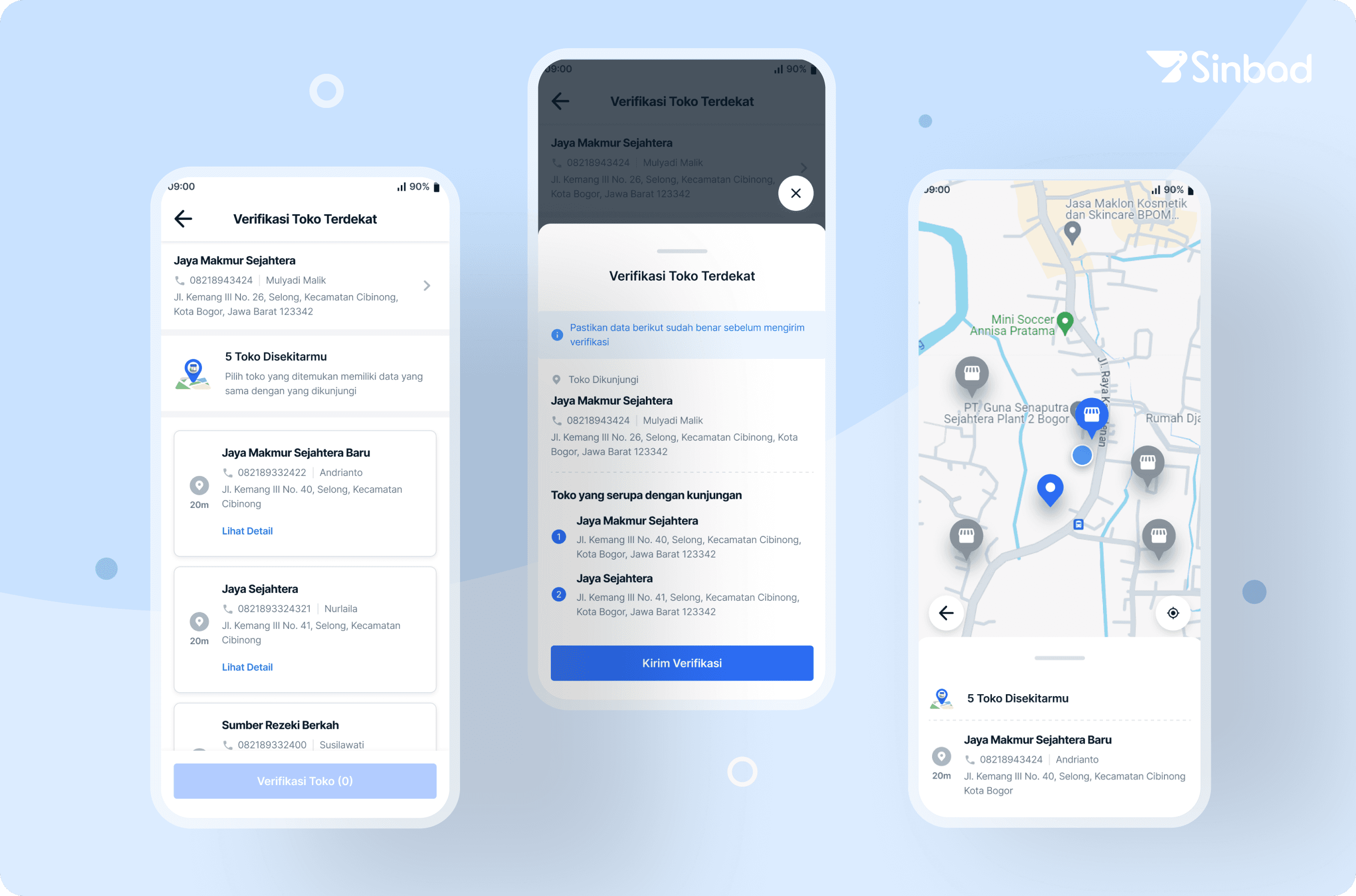
Product Designer
Sinbad Agent App
Sinbad
2024
Background
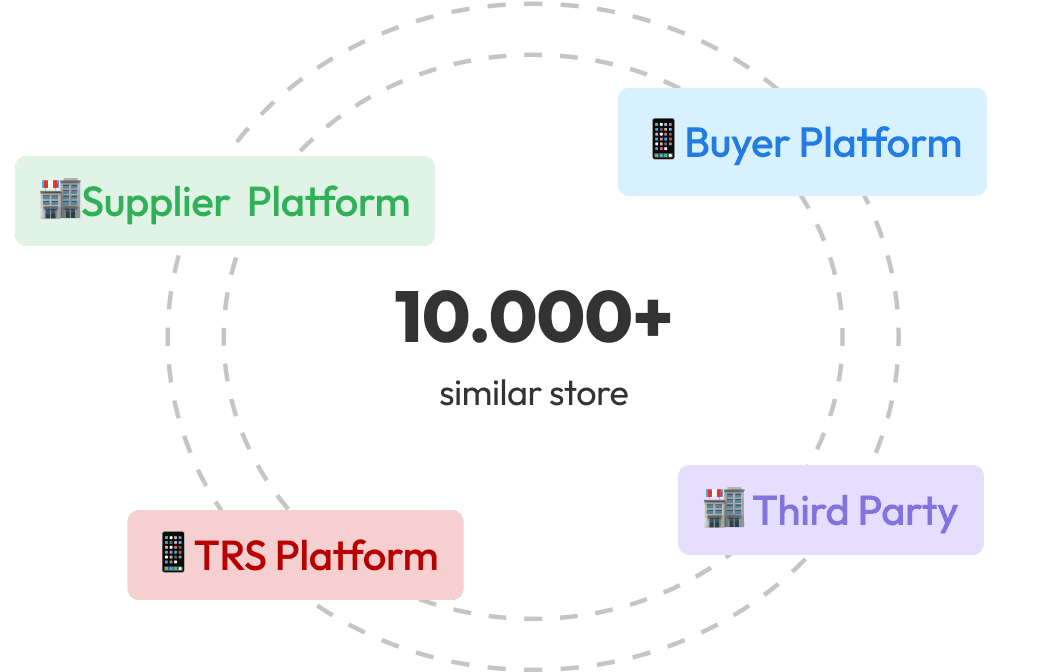
In early 2024, we identified over 30,000* similar stores across the Sinbad ecosystem, including buyer, supplier, TRS, and third-party platforms. This caused major issues with store management, led to inaccurate order and store visit data, and significantly increased operational costs. Despite our efforts, progress has been slow, with only 3% of the similar stores unified in the end of February.
*the specific number is rounded and omitted due to NDA restrictions.
🏬 Similar Store Distribution
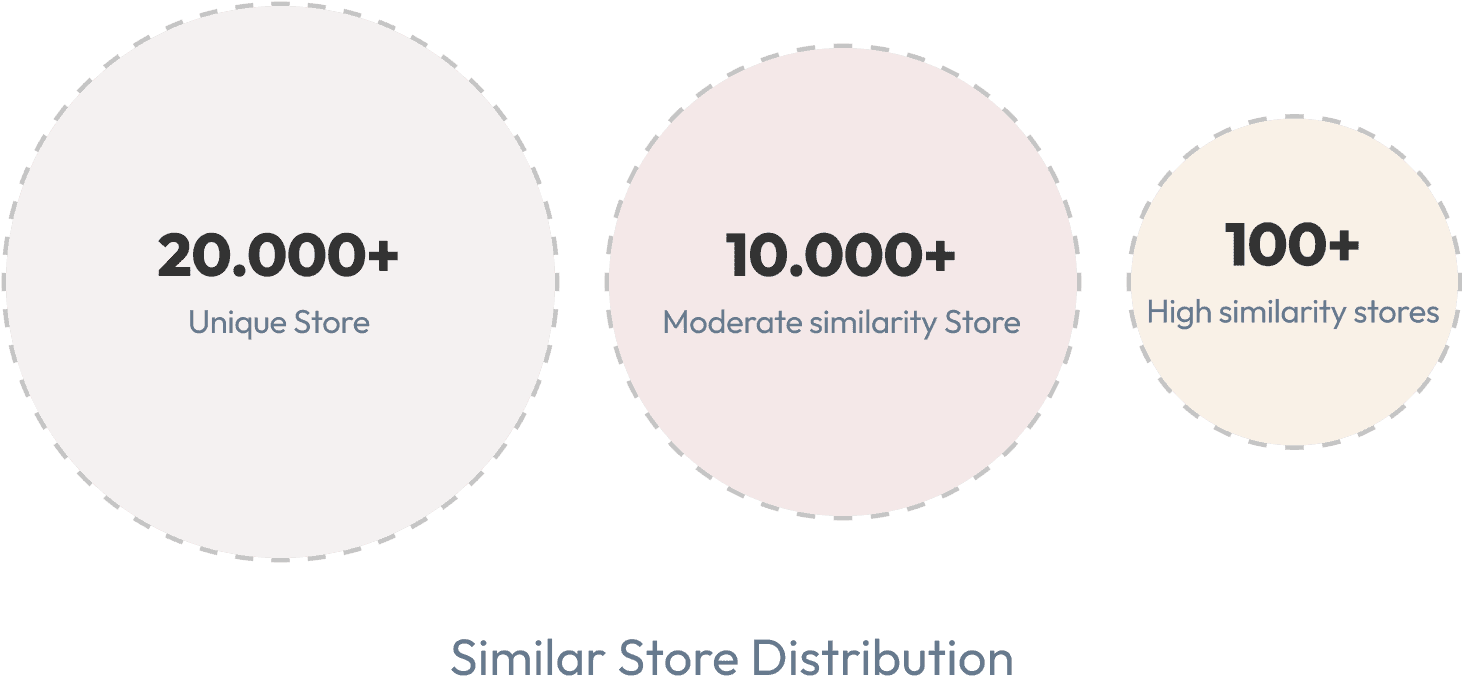
Our data analysis reveals three clusters of similarity scores: stores with less than 30% similarity (unique stores), stores with moderate similarity (30-69%), and stores with high similarity (over 70%). (Thanks to data team helping us defining the clusters!)
Based on the findings from store clustering, a store is suspected to be a similar store if it shares most of the following data:
Address and pinpoint location
Store name
Store owner's name
🔍 Diving into the Issues
Even though the store unification feature on the Admin Panel has been created, allowing the CS team to flag and unify similar stores, the process remains slow due to the following reasons:
🧑🏻💻
The Store Unification on the Admin Panel is currently managed solely by the CS team. Given their heavy workload and the high volume of data, this approach is insufficient, leading to delays and incomplete unification.
🐌
To verify a similar store, the CS team must make a confirmation call to the store, resulting in a time-consuming and slow unification process.
The Four Keys to Clarity✨
To ensure project clarity, we're focusing on establishing four key areas:
📅
Timeline
We set a one-year timeline for completion, with milestones to be reviewed and shared quarterly. This will help us track progress and make necessary adjustments along the way.
🏆
Success Metric
Our primary measure of success will be the completion of store unification for stores with high and moderate similarity scores. This will serve as a clear indicator of the project's effectiveness and progress.
🤵🏻♂️
Additional Resource Needed
To streamline the unification process, additional resources are needed to assist the CS team in verifying similar stores. The sales team, being in constant contact with the stores, is ideally positioned to help with this task.
🤚🏼
Prevention Strategy
To prevent similar or duplicate store entries, we will lock the NIK (Nomor Induk Kependudukan) as the unique identifier, ensuring each store can only be entered once.
🔍 Dig Deeper to the Sales Team Responsibility
An overview of the sales team’s main tasks during store visits, each with specific KPIs to be achieved:
🤵🏻♂️
Collecting store debt from the last order💰
Taking store orders (for registered Sinbad users)🛒
Registering new stores (if not yet registered as a Sinbad user)🏬
Conducting stock opname📦
With all these main tasks, it became clear that the new store verification task couldn’t hold the same priority as the existing core responsibilities. Our goals is to make sure the new task won't disrupting their main tasks during store visits.
🔍 Deep Dive into the Store Visit Journey
During store visits, the sales team uses the Sinbad Agent app to log visit records based on their assigned tasks. A review of the existing app flow was conducted to gain a deeper understanding of its structure and functionality.
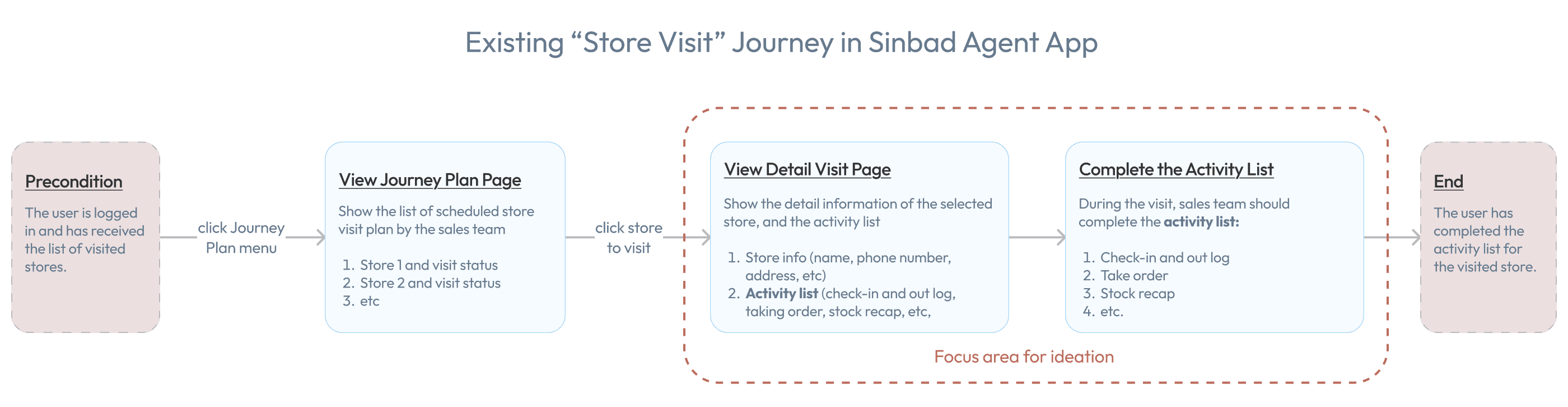
The store unification verification process will begin on this "Detail Visit" page.
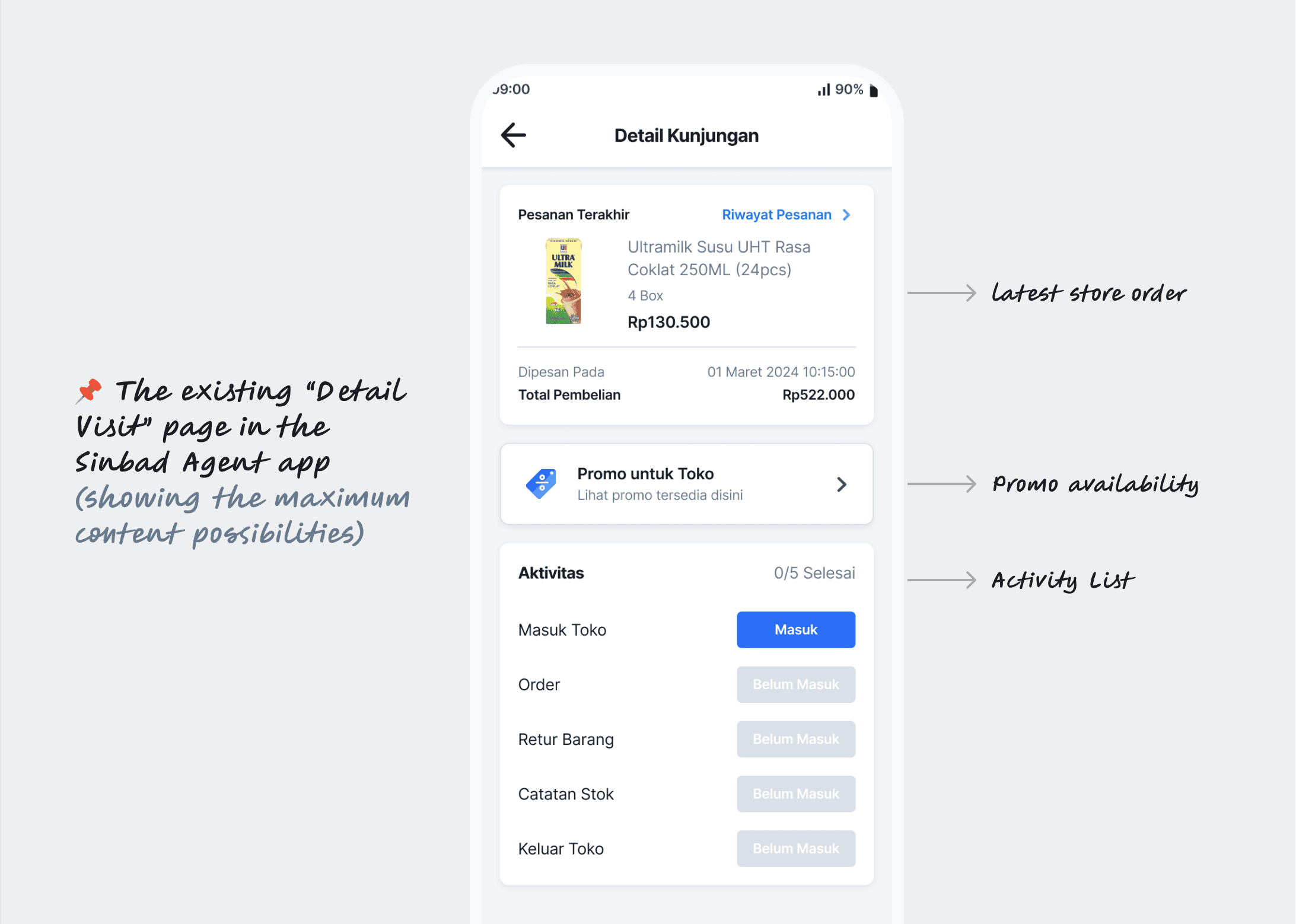
🔑 Key Considerations in the Sales Team’s Store Verification Journey
After assessing the current store visit journey in the Sinbad Agent app, our challenges and goals have become clear.
Presenting Store Data
How might we present the store list data without overwhelming the user, making it easier to understand and complete the task?
Ensuring Accuracy
How might we ensure the sales team performs the verification correctly to provide accurate data for review and minimize human error?
Ensuring the Usability
How might we improve the user experience for the new store verification task? How can we refine the existing design pages to enhance usability?
Get to Know the New Workaround
Here’s a simple illustration of the new store unification flow, highlighting the collaboration between the Sales team and Customer Service. The CS team will focus on high-similarity stores, while the Sales team will handle moderate-similarity stores.
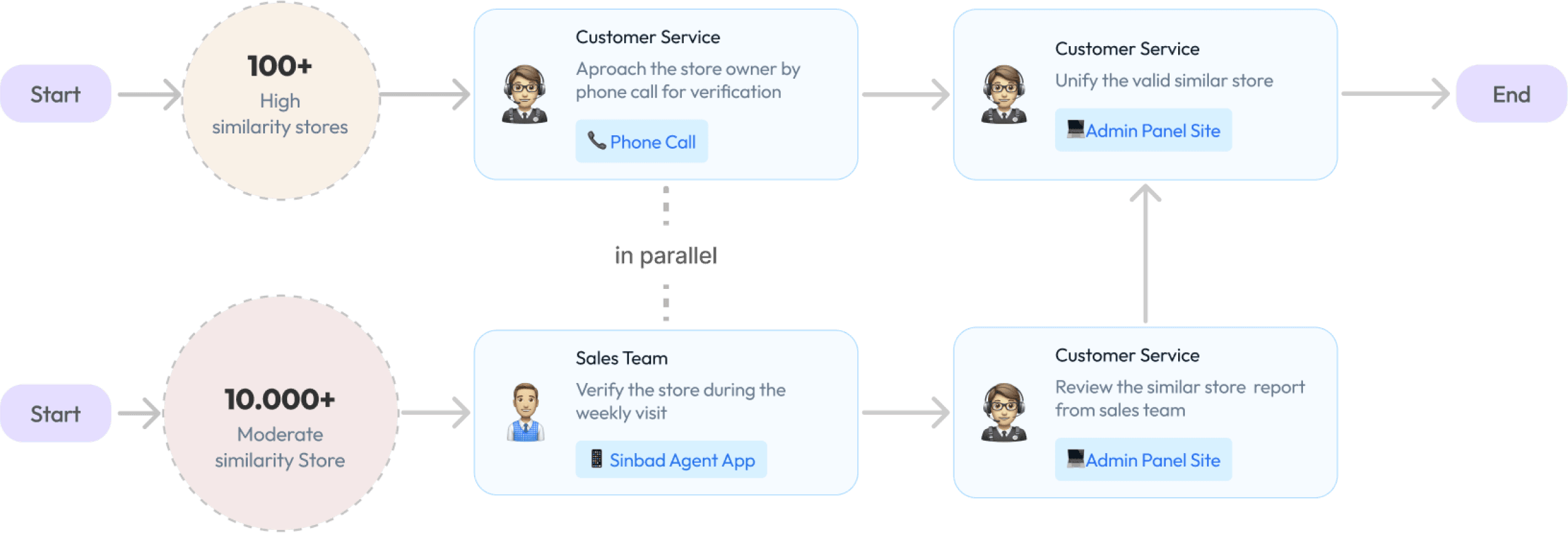
The New User Stories & Journey
With all key considerations in mind and the new workaround, here are the user stories for implementing store unification in the Sinbad Agent app.
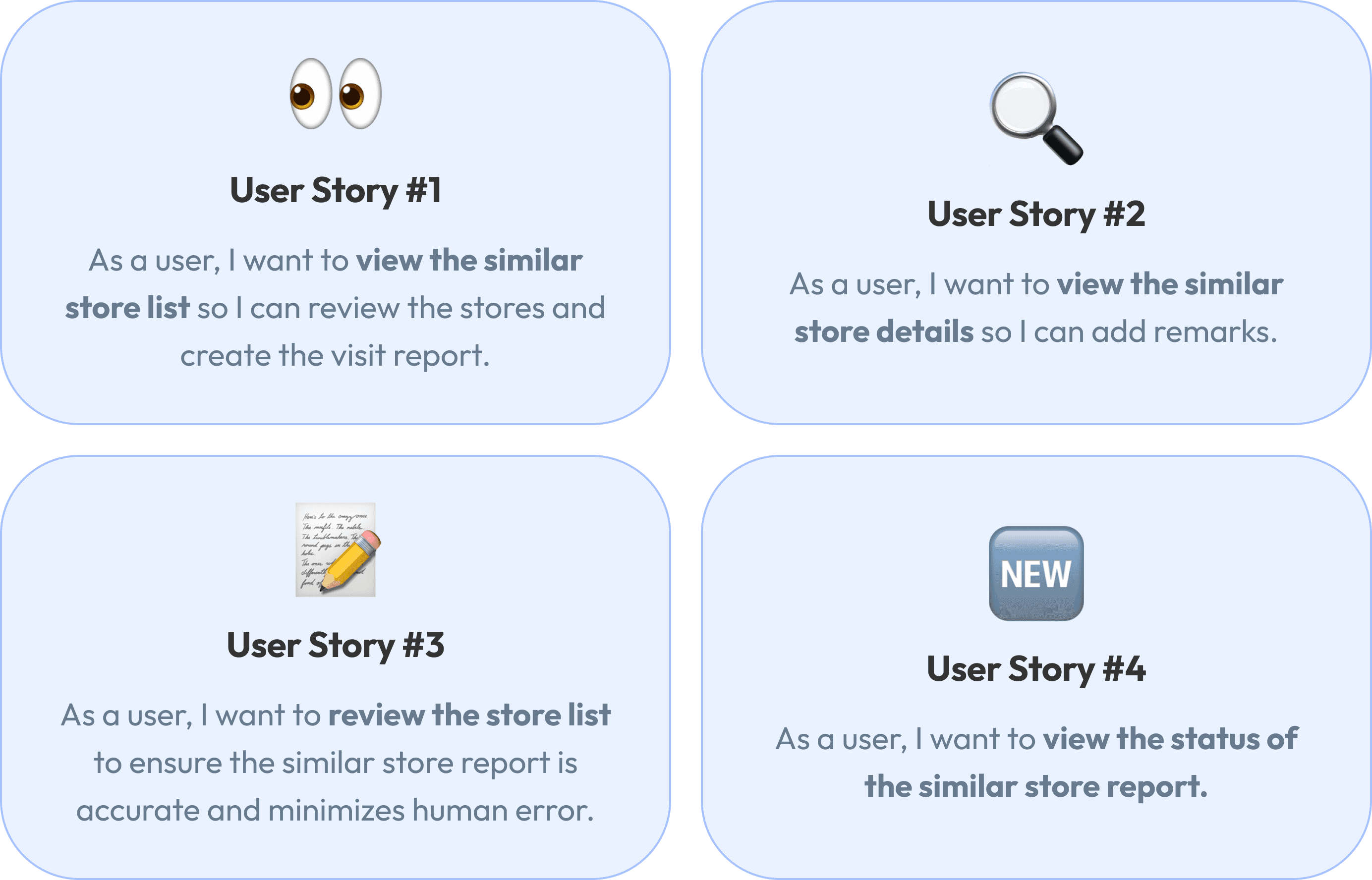
Here’s the main journey for the Sales Team to verify similar stores. Since displaying the entire similar store list in the Sinbad Agent app isn’t feasible, we found a new approach: showing a list of nearby stores based on the Sales Team’s location during the visit (journey number 2). Keep in mind, the store's address and pinpoint location are key factors in the store similarity clustering, right?
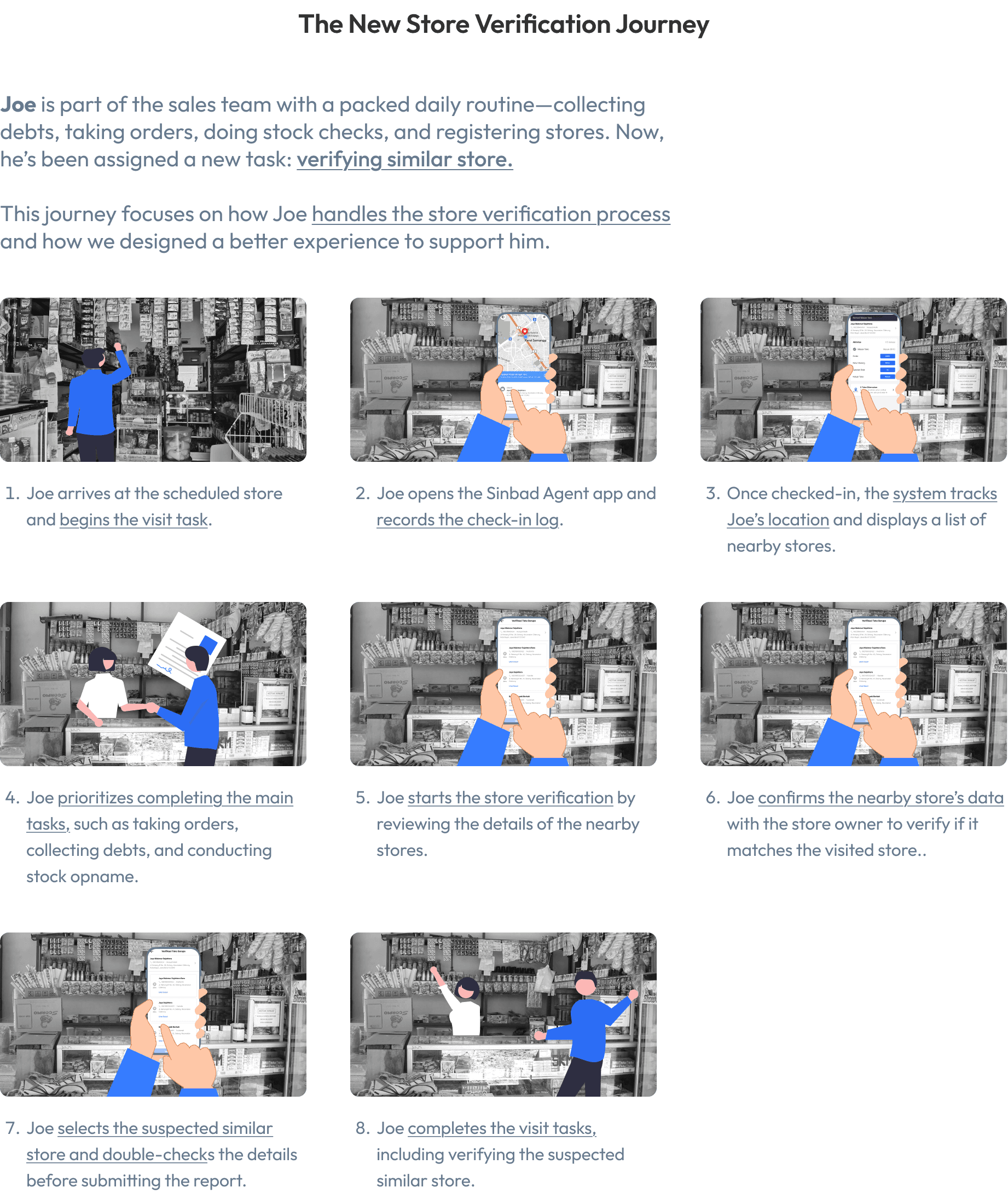
🧩 Exploring Design Possibilities
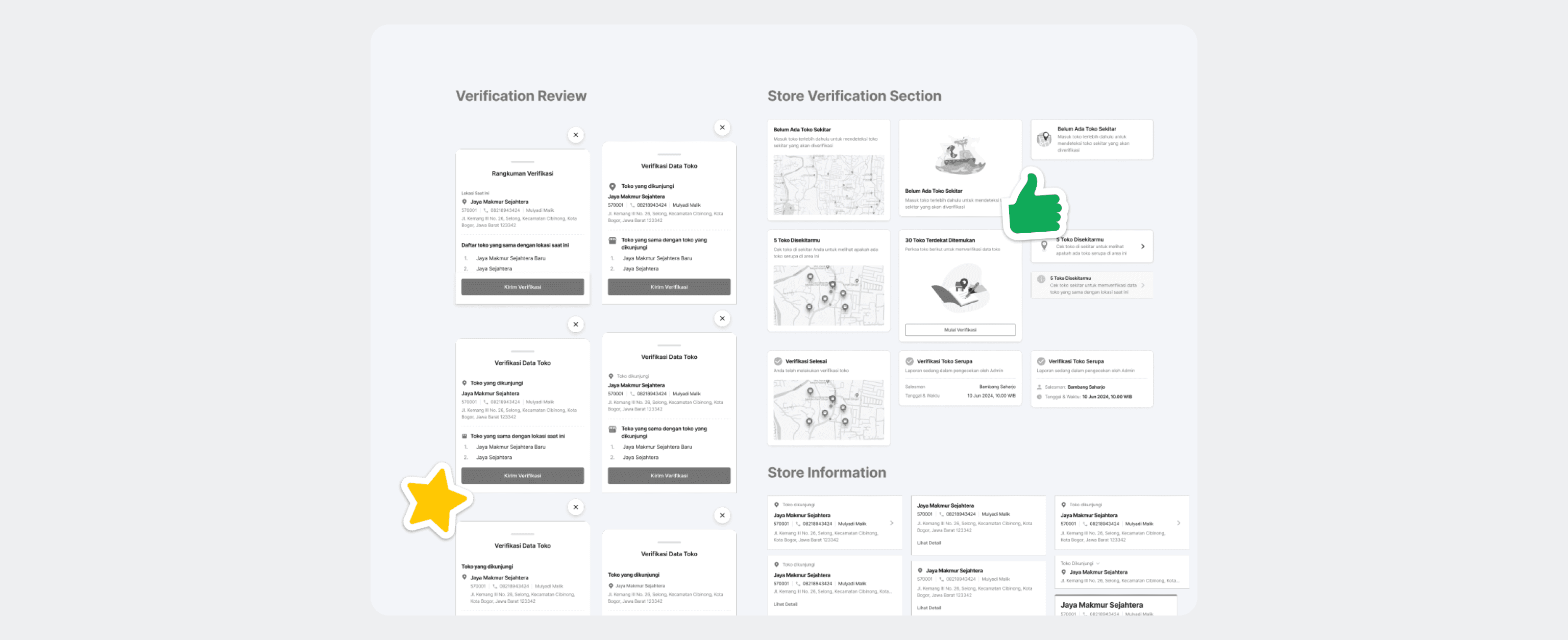
To enrich the concept, I explored design references from popular apps like Gojek, Tiket, and Tokopedia—drawing insights from their UX patterns to sharpen and elevate the idea.
The goal was to keep the UI clear, intuitive, and efficient to build—avoiding solutions that would require too many sprints. That’s why I applied system thinking: to ensure alignment with the existing design system and reduce unnecessary rework.
I also considered the development impact of each component—from default to selected states, shimmer effects, and more. Exploring multiple possibilities early on helped balance creativity with feasibility.
✍🏻 The Final Touch: Completing Design Scenarios and Flow
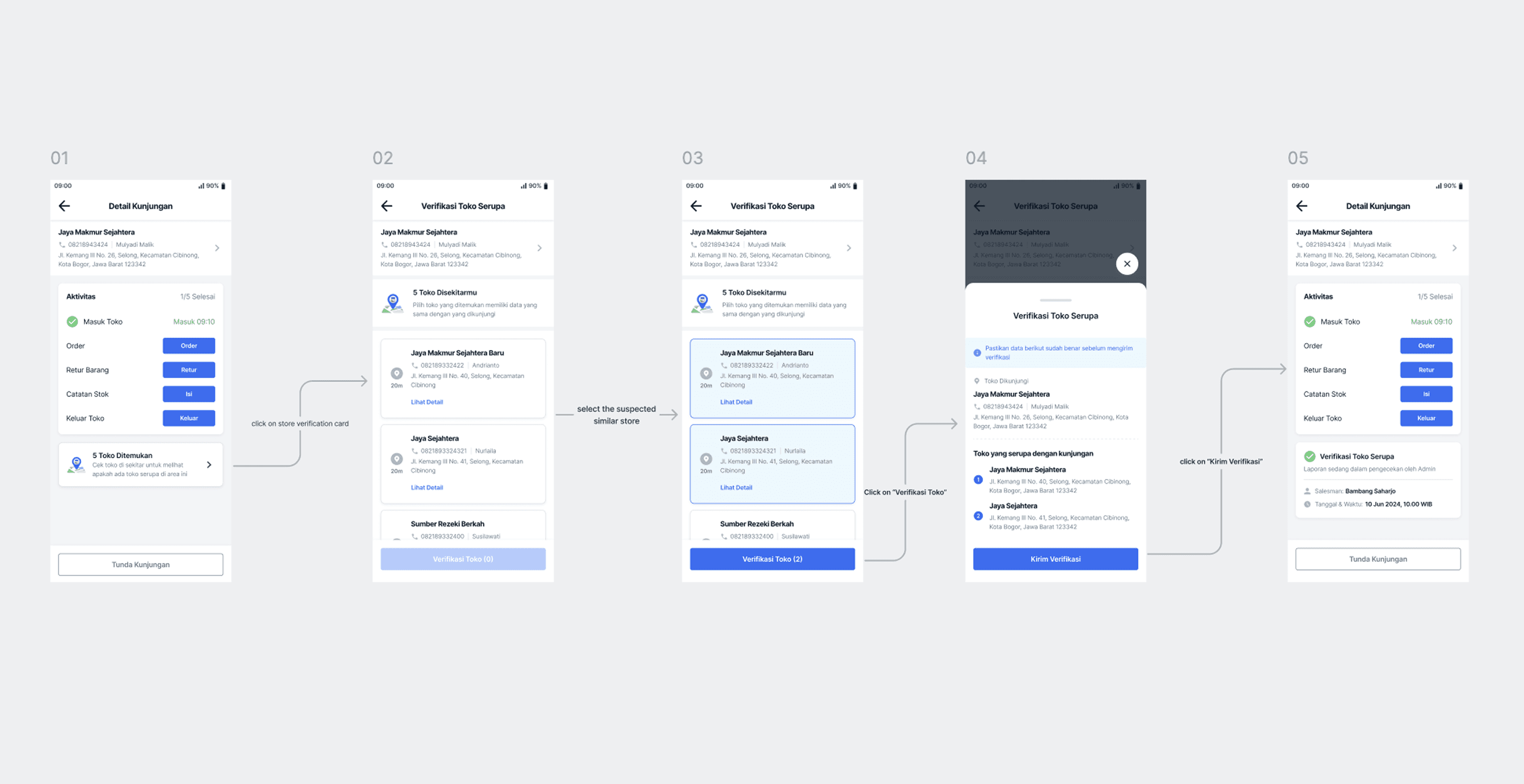
After finalizing the core components, I translated user stories into high-fidelity screens—focusing on clarity, simplicity, and user needs.
This phase brought the new store verification journey to life. I completed both positive and negative scenarios, ensuring each flow was realistic and ready for handoff. In parallel, I prepared all necessary component variants and collaborated closely with the dev team to ensure everything was clear, feasible, and aligned with the design system.
🔁 Feedback Frenzy: Iterating for Success
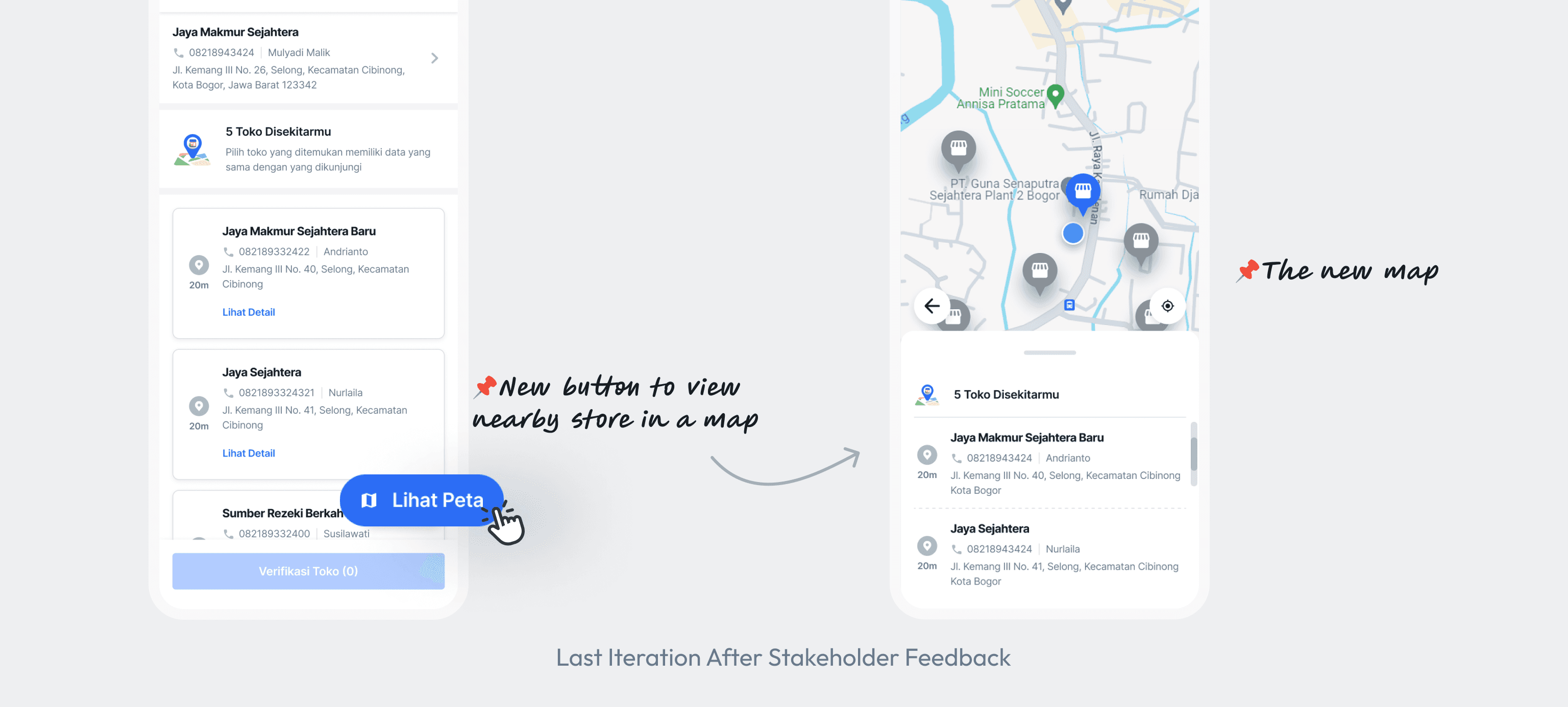
Due to time constraints, testing the feature with the sales team directly was not possible. Instead, feedback was collected from stakeholders through a prototype presentation. Based on their input, the decision was made to add a map page to the feature, allowing sales team to view the actual locations of nearby stores.
Did We Hit Our Targets?🤔
Not quite there yet. A month after launch, store unification only improved by 4%. So, what happened?
Our CS team—already juggling multiple tasks—had limited bandwidth. The sales team, while involved, couldn’t prioritize store unification during store visits due to their main KPIs. With both teams stretched thin, progress was slower than expected.
Just as we were gearing up to reassess and push forward... plot twist: the whole team got laid off, and everything came to a halt 😥
⬆️+ 4%
Progress of store unification
🏃🏻1
Sprint completion
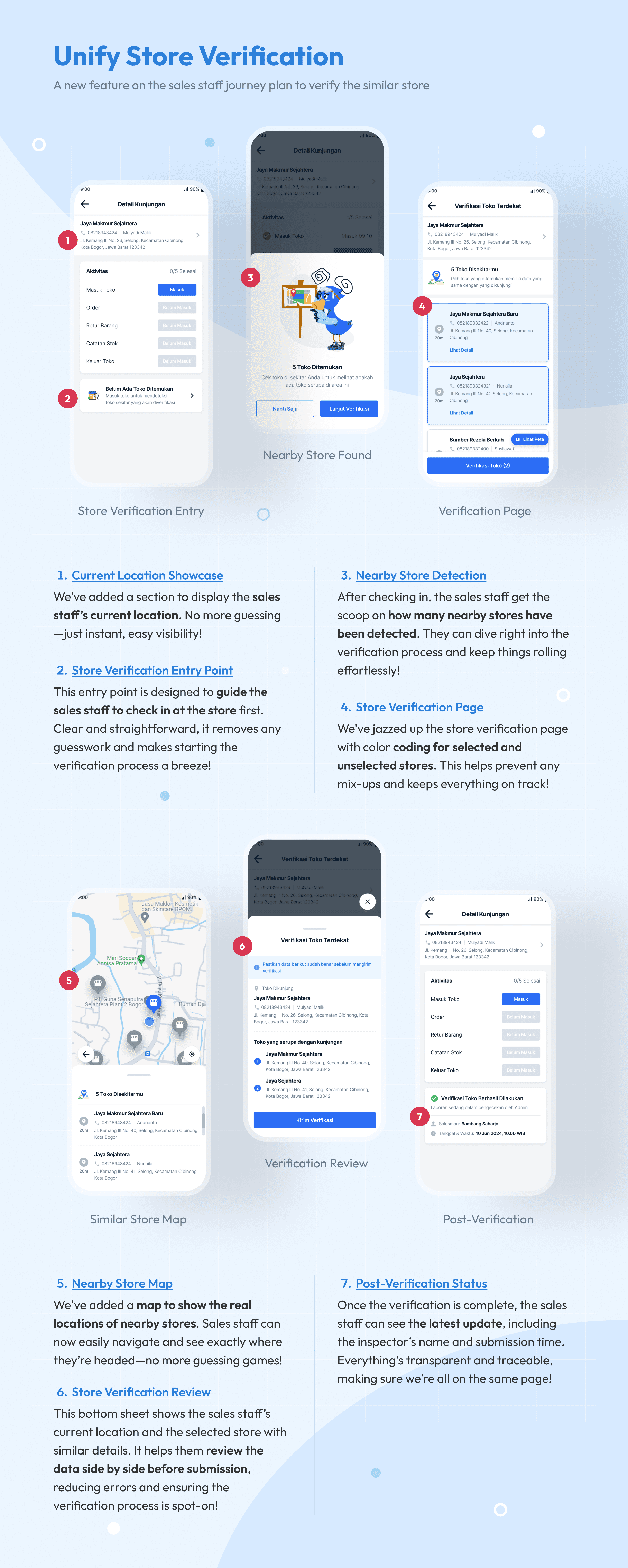
👀 What I Discovered on This Design Adventure
Team Capacity Matters
I realized that no matter how solid our solution is, if key players are stretched thin, progress will inevitably slow down.
Prioritize Priorities
I’ve learned that aligning new tasks with the team's main goals is crucial; if it’s not a priority for them, it simply won’t get done.
Adapt and Reassess
I discovered that flexibility is key! When things aren’t going as planned, it’s important to pivot and reassess—just be sure we’re ready before the unexpected arrives.